
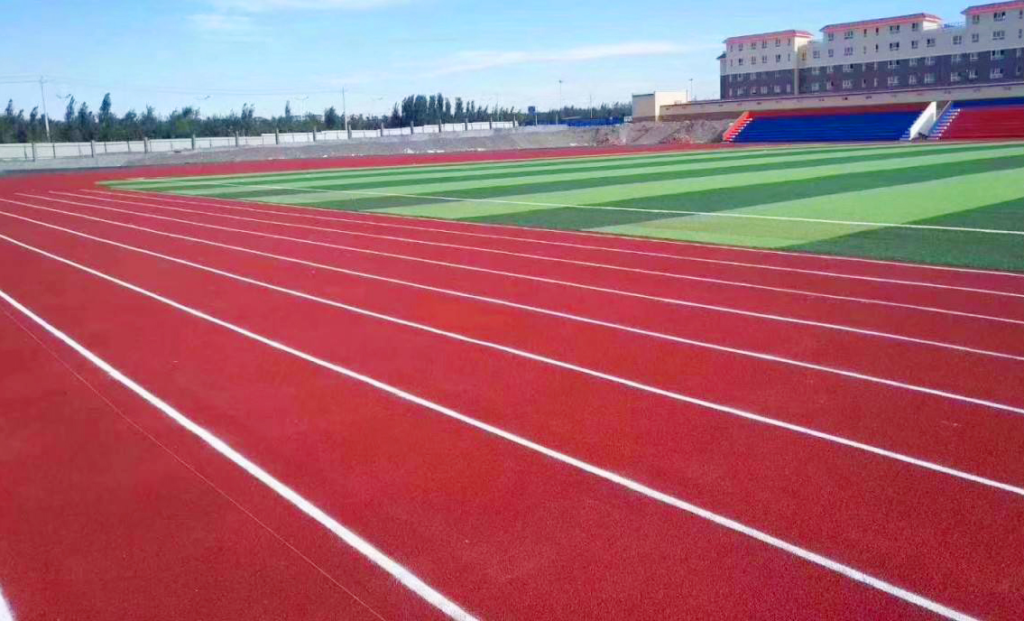
To improve the construction quality of school sports fields , regulate the market for school sports fields and equipment, and safeguard the interests of schools and construction units, the School Sports Equipment Branch of the China Educational Equipment Industry Association conducts acceptance inspections of the functionality of newly built and renovated school sports fields in accordance with relevant national regulations, standards, and competition rules of sports events. This is to protect the physical and mental health and safety of students and ensure the normal conduct of school physical education teaching, extracurricular sports training, sports competitions, and mass sports activities.
I. Acceptance Criteria
(a) GB 50099 Design Code for Primary and Secondary Schools (with Explanatory Notes)
(II) JGJ/T 280 Technical Specifications for Sports Facilities in Primary and Secondary Schools
(III) The latest national product quality standards
(iv) Competition rules for relevant sports events
(v) The design drawings of the site and the construction contract signed between the school and the construction unit.
II. Scope of Acceptance
The school has newly built or renovated sports fields for track and field, football, basketball, volleyball and other sports.
III. Acceptance Procedure
(i) The construction unit or the user unit shall submit a written application for acceptance to the School Sports Equipment Branch of the China Educational Equipment Industry Association. The two parties shall negotiate and determine the acceptance time. The applicant unit shall also submit the following materials:
1. A copy of the project contract (stamped with the official seal).
2. Construction design drawings and as-built drawings.
3. Inspection reports, commodity inspection reports (for imported goods), and environmental protection test reports from testing institutions recognized by relevant national departments for the synthetic material surface layer, artificial sports turf, and wooden flooring of the completed site.
4. Self-inspection reports and related materials on the flatness, thickness, slope, and location lines of the synthetic material surface layer, artificial sports turf, and wooden floor.
5. Summary of the supervision work for the basic project, completion report, and related materials.
6. Summary of supervision work and completion acceptance report for synthetic material surface layer, artificial sports turf, and wooden flooring projects.
(II) Document Review
The expert review panel of the School Sports Equipment Branch of the China Educational Equipment Industry Association reviewed the relevant materials submitted by the applicant units.
(III) On-site testing and inspection
The expert review panel of the School Sports Equipment Branch of the China Educational Equipment Industry Association conducted an inspection of the school sports fields that applied for acceptance. The contents are as follows:
1. Whether the completed site matches the submitted acceptance documents.
2. Whether the flatness, thickness, and slope of the synthetic material surface layer, artificial sports turf, and wooden flooring meet the technical requirements.
3. Check the appearance of the synthetic material surface layer for bubbles, cracks, or delamination, and whether the seams are straight and without obvious marks.
4. Whether the bonding between the synthetic material surface layer and the base is firm, and whether the joints of the artificial sports turf are firm, have consistent color, and good overall integrity.
5. Whether the control points, position lines, and marker lines of the synthetic material surface layer and artificial sports turf are clear, accurate, firm, without obvious blurred edges, non-reflective, and comply with the relevant sports competition rules.
6. Whether the grass seedlings on the natural grass football field are uniform and flat, and whether the flatness, slope and drainage system meet the technical requirements.
7. Whether the surface material, appearance quality, processing precision of the floorboards, environmental protection requirements, coating performance, flatness, bonding layer, load distribution layer, ventilation facilities, and anti-deformation measures of the wooden flooring venue meet the technical requirements, and whether the venue specifications and markings comply with the relevant sports competition rules.
8. Site safety inspection: Check the size of the sports field buffer zone (barrier-free zone), whether there is a difference in elevation between it and the surrounding ground, whether there are instructions for use of the sports field (warning signs), and whether there are any other safety hazards inside and outside the field.
(iv) Acceptance Results
1. The expert review panel of the School Sports Equipment Branch of the China Educational Equipment Industry Association will issue an acceptance report based on the acceptance materials submitted by the applicant and on-site testing.
2. The School Sports Equipment Branch of the China Educational Equipment Industry Association will issue qualification certificates to the construction units of school sports fields that have passed the acceptance inspection and provide signs for the fields.
3. The expert inspection team of the School Sports Equipment Branch of the China Educational Equipment Industry Association raised issues and suggestions for rectification for sports fields that did not meet the technical requirements, and will conduct a second inspection after rectification.
(v) Acceptance fee
1. The applicant shall pay the acceptance fee at the same time as submitting the application for acceptance.
2. Acceptance Fee Standard: Site Area/square meter Member Price/yuan Non-member Price/yuan ≥15000 18000 19800 10000~15000 15000 16500 ≤10000 12000 13200 The fee for a second acceptance is 50% of the fee for the first acceptance.
3. The acceptance fee covers the expert acceptance team’s review of acceptance documents and on-site acceptance, including travel, accommodation, transportation, instrument usage, and certificate/label production.
IV. Expert Acceptance Group
(I) Composition of the Expert Acceptance Team The School Sports Equipment Branch of the China Educational Equipment Industry Association has appointed experienced personnel with professional knowledge and senior professional titles to form an expert pool for the acceptance of school sports fields. Members of the expert acceptance team are drawn from this pool, and the acceptance of each field is conducted by 2 to 3 people, who carry work permits and letters of introduction for the acceptance of school sports fields.
(II) Requirements for the Expert Acceptance Team
1. Members of the expert review panel should adhere to the principles of science and objectivity in the review process, and ensure accuracy, fairness, and a fact-based approach.
2. During the acceptance process, we must be humble, cautious, conscientious, and polite, and provide excellent service to safeguard the interests of the school and the construction unit, as well as the reputation of the School Sports Equipment Branch of the China Educational Equipment Industry Association.
3. Adhere to principles, keep secrets, do not abuse power or engage in fraud, and do not accept any hospitality or gifts from the inspected unit.
4. During the acceptance process, no individual member of the expert acceptance team may have individual contact with the unit being accepted regarding acceptance matters, nor may they disclose any information related to the acceptance work. No individual member may draw any conclusions regarding the acceptance site.
5. Members of the expert review team shall not engage in personal activities in the name of the School Sports Equipment Branch of the China Educational Equipment Industry Association, except for the work assigned by the branch.
6. Members of the expert review team should consciously abide by the work requirements. If they damage the reputation of the School Sports Equipment Branch of the China Educational Equipment Industry Association due to violations of the work requirements, they will be removed from the expert database for the acceptance of school sports venues of the School Sports Equipment Branch of the China Educational Equipment Industry Association, and their respective units will be notified.
V. The right to interpret these Measures belongs to the School Sports Equipment Branch of the China Educational Equipment Industry Association.
Technical requirements for acceptance of school sports fields
I. Synthetic running track of athletic field
1. Appearance: No cracks or delamination; the anti-slip layer and the base adhesive are firmly and evenly bonded; the seams are straight and there are no obvious unevenness; the surface color is uniform.
2. Marking lines: Marking lines should be clear, non-reflective, without obvious blurred edges, and firmly adhered to the surface layer. The distance between each marking line and the finish line should not have a negative difference, and the positive difference should be less than 1/10000. The width of the track line is 5 cm; the width of the javelin throwing arc is 7 cm; and the width of the line flush with the inner edge of the top of the pole vaulting bucket is 1 cm.
3. Flatness pass rate: The flatness pass rate of the plastic running track shall not be less than 85%. In any direction and position, the undulation shall not exceed 3 mm in every 2-meter measurement distance; and the undulation at any point shall not exceed 10 mm.
4. Thickness: The thickness of synthetic running tracks used for competitions shall not be less than 13 mm, and the thickness of any area shall not be less than 10 mm. The area with a thickness between 10 and 10.5 mm shall not exceed 5% of the total area. Thickened areas: The last 8 meters of the pole vault runway, the last 8 meters of the javelin throw runway, the 13-meter take-off area for the triple jump, and the 3×5-meter take-off area for the high jump shall have a thickness of 20 mm. The bottom of water tanks shall have a thickness of 25 mm. Primary and secondary school track and field: Mixed type ≥ 10 mm, permeable type ≥ 12 mm, composite type ≥ 11 mm.
5. Slope: The lateral slope of the plastic running track shall not exceed 1:100, and the longitudinal slope shall not exceed 1:1000.
6. Physical and mechanical properties shall meet the requirements specified in the table below: | Item | Index | Primary and Secondary School Indicator | |—|—|—|—| | Hardness (Shore A), degree | 45-60 | 35-50 | | Tensile strength, MPa | 0.7 | ≥0.5 | | Elongation at break, % | 90 | 90 | | Compression recovery, % | 95 | ≥90 | | Rebound value, % | 20 | 20 | | Flame retardancy, grade | 1 | 1
II. Plastic courts for football, basketball, volleyball, etc.
1. Appearance: The site is free of bubbles, cracks or delamination; the surface layer and base layer are firmly and evenly bonded, the joints are straight and there are no obvious unevenness; the surface is flat and the color is uniform.
2. Marking lines: The marking lines are clear, non-reflective, without obvious blurred edges, and firmly adhered to the surface layer.
(1) All lines on a football field shall not exceed 12 centimeters in width. The field shall be 90-120 meters long and 45-90 meters wide. For international matches, the field shall be 100-110 meters long and 64-75 meters wide. For indoor football matches, the field length shall be 25-42 meters and the width 15-25 meters. For international matches, the field length shall be 38-42 meters and the width 18-22 meters. The football field for primary and secondary schools shall be determined according to the requirements of the football rules approved by the Chinese Football Association and the actual conditions of the school. However, the field must be rectangular and the length of the sidelines must be longer than the length of the goal lines.
(2) All lines on a basketball court are 5 centimeters wide. The main official competition court dimensions of FIBA are 28 meters long and 15 meters wide. The court measurements are taken from the inside edge of the boundary lines. The minimum court size is 14 meters × 26 meters. There must be no obstructions for at least 2 meters outside the basketball court boundary lines.
(3) All lines of the volleyball court are 5 cm wide. The playing area is a rectangle of 18 meters × 9 meters, with a free zone of at least 3 meters wide around it. The boundary lines of the volleyball court are measured from the outer edge of the lines.
(4) The end lines of a tennis court are 10 cm wide, and the other lines are 5 cm wide. The singles court is 23.77 m × 8.23 m, and the doubles court is 23.77 m × 10.97 m. All measurements are taken to the outer edge of the lines. There should be at least 6.4 m of open space outside the end lines and at least 3.66 m of open space outside the sidelines. The size of the court may be appropriately reduced if there is no space outside the end lines and sidelines in primary and secondary schools.
(5) The width of the lines in the handball court is 5 cm, the length of the court is 40 m, the length of the goal line is 20 m, there is no obstacle zone outside the court, and the distance from the sideline is at least 1 m and the distance from the goal line is at least 2 m. All measurement lines are measured from the outside edge of the lines.
(6) The badminton court has a line width of 4 cm, a court length of 13.4 m, a doubles court width of 6.10 m, a singles court width of 5.18 m, and no obstacles within 2 m around the court. All measurements are taken from the outside of the lines.
3. Flatness qualification rate: The flatness qualification rate of the sports field should not be less than 85%. In any direction and position, the undulation should not exceed 3 mm over a 2-meter measurement distance; and the undulation should not exceed 8 mm at any point.
4. Thickness: The thickness of football, basketball and volleyball courts shall not be less than 8 mm, and the thickness of tennis and badminton shuttlecocks shall be 5-8 mm.
5. Slope: The surface of the court should be sloping in a turtle-back shape. The lateral slope of basketball, volleyball and tennis courts in primary and secondary school sports fields should not exceed 7:1000, and the longitudinal slope should not exceed 5:1000.
6. The physical and mechanical properties are the same as the plastic mechanical properties of the relevant field standards for track and field plastic running tracks.
III. Artificial Sports Turf
1. Artificial sports turf for primary and secondary schools is available in two types of fibers: monofilament (straight and curly) and open-web turf (straight and curly). Different specifications are distinguished by fiber type (Tex), longitudinal density (clump/m), transverse density (row/m), and fiber height (mm). Technical requirements for artificial sports turf, such as dimensional specifications and tolerances, appearance, physical and mechanical properties (water permeability, flame retardancy, coefficient of friction), environmental protection requirements, acid and alkali resistance, organic matter resistance, photochemical resistance, and fiber abrasion, must comply with the relevant requirements of the national standard GB/T20394.
2. Appearance: The surface is basically flat, without obvious unevenness; the density is uniform, without obvious exposed needles; there is no obvious color difference; there are no obvious glue spots on the grass fiber surface, the base fabric is evenly coated with glue, and there is no damage; the longitudinal and transverse spacing is uniform, without obvious crooked lines or skipped lines; the turf joints are flat and firmly bonded; the grass seedlings are soft, comfortable, and elastic, with good safety and resistance to trampling and impact.
3. The performance requirements related to the interaction between the football and the artificial turf shall comply with the provisions in the table below: | Item | Requirement | |—|—|—|—| | Ball bounce rate/% | 30-50 | | Ball roll distance/m | 4-10 | | Angle ball bounce rate (50km/n, 15° angle of incidence)/% | 45-70 |
4. The performance requirements related to the interaction between athletes and artificial turf shall comply with the provisions in the table below: | Item | Requirement | |—|—|—| | Shock Absorption/% | 55-70 | | Vertical Deformation/mm | 4-9 | | Traction Coefficient, μ | 1.2-1.8 | | Sliding Resistance | 120-220 |
5. Tensile strength and connection strength: The tensile strength of the lawn underlayment and the connection strength at the joints are both greater than 15 N/mm.
6. Water permeability rate: The water permeability rate of the paved surface layer is greater than 3 mm/min.
7. Slope: The slope perpendicular to the long axis of the site should not exceed 8‰ for sites without permeability and not exceed 3‰ for sites with permeability.
8. Flatness: The ground should not be uneven in any area, and the gap should not exceed 10 mm within a 3-meter diameter range.
9. Drainage: There should be no standing water on the lawn 20 minutes after the rain stops.
10. Filling Requirements: Fill the grass seedlings with smooth, rounded sand (quartz sand or natural foundry sand with a silicon content of over 90%), using elastic, environmentally friendly granules. Spread the sand evenly. The sand filling thickness should reach 1/3 of the grass seedling height, the granule filling thickness should reach 1/3 of the grass seedling height, and the remaining 1/3 of the grass seedling height should be covered.
11. Marking lines: Marking lines should be clear and non-reflective. Marking lines can be directly woven into the lawn or cut and glued on site. Strong adhesive tape should be laid at the joints for connection or sewing. They should not be directly glued to the foundation.
12. Buffer layer: It is recommended to lay an environmentally friendly buffer layer with a thickness of not less than 10 mm under the artificial sports turf.
IV. Natural Grass Football Field
1. Appearance: Uniformity requirements: (1) No obvious color difference in the lawn, (2) No bare ground visible to the naked eye, (3) The number of weeds (number of upward-growing stems) is less than 0.05%, (4) No obvious disease characteristics visible to the naked eye, (5) No obvious insect pest characteristics visible to the naked eye. The sum of the five scores represents uniformity, and the score should be ≥15 points. The score for each item should be ≥3 points.
2. Site slope: The acceptable value is no greater than 5‰, and the optimal value is no greater than 3‰.
3. Stem density: The number of upward-growing stems per unit area. The acceptable value should be (1.5-4) stems/cm2, and the optimal value should be (2-3) stems/cm2.
4. Flatness: The degree of unevenness of the lawn surface. The relative height difference between any two points within a 3m length range should not exceed 30mm for the qualified value and 20mm for the optimal value.
5. Grass height: The grass seedlings should be maintained at the most suitable height of 3-4cm to ensure the longest lifespan of the turf surface. When throwing events are held on the football field, the grass height should be 1.5-2cm.
6. Surface hardness, traction absorption, ball rebound rate, ball rolling distance, root layer ratio, water rate, permeable layer permeability rate, organic matter and nutrient supply must comply with the relevant provisions of national standards.
7. Environmental protection requirements: Substances or materials that are hazardous or emit pollutants that are harmful to people, soil, water or air should not be used.
8. The leaf width should not exceed 6mm. Suitable grass species can be selected according to the specific conditions of each region.
9. Drainage: There should be no standing water on the ground 20 minutes after the rain stops.
10. Water supply: Even spraying, with no blind spots.
V. Wooden Flooring for Comprehensive Sports Stadiums
1. Timber species: The surface of the selected timber should not easily produce splinters. Commonly used species include oak, ash, birch, maple, and beech.
2. Product performance requirements: Commonly used wood flooring includes solid wood flooring, engineered wood flooring, solid wood integrated flooring, bamboo flooring, etc. The appearance quality, specifications, physical and mechanical properties, physical and chemical properties, and functional indicators of various types of flooring must meet the relevant requirements stipulated in the national standard GB/T 20239.
3. The performance indicators of sports venue wooden flooring should meet the requirements in the table below: | Content | Performance Indicator | Sports Competitions | Sports Activities | |—|—|—|—| | Impact Absorption 1% | ≥53 | ≥40 | | Ball Rebound Rate 1% | ≥90 | ≥75 | | Rolling Load 1N | ≥1500 | ≥1500 | | Sliding Friction Coefficient/μ | 0.4—0.6 | 0.4—0.7 | | Standard Vertical Deformation/mm | ≥2.3 | Not Required | | Vertical Deformation Rate W500/% | ≥15 | Not Required | Note: 1. The vertical deformation rate W500 indicator is not required for venues below the level of general international competitions and for fitness purposes. 2. The ball rebound rate is not required for venues below the level of national competitions without basketball and for fitness purposes.
4. Site appearance: It shall comply with the relevant requirements of Chapters 3 and 6 of GB 50209. The allowable deviations of items such as the width of the board gap, the flatness of the surface, the straightness of the board joints, and the height difference between adjacent boards shall comply with the provisions of 7.1.7 of GB 50209.
5. Flatness: The surface of the laid wooden floor layer is measured with a 2m straightedge, and the gap is no more than 2mm; the site is generally flat, and two points arbitrarily selected 15m apart on the site are measured with a level instrument, and the difference in elevation is no more than 15mm.
6. Coating performance: The color of the coating does not affect the identification of the field markings, the reflectivity does not affect the athletes’ performance, and it has the characteristics of wear resistance, slip resistance and flame retardancy.
7. Ventilation facilities: The sports floor structure must have ventilation facilities to ensure good ventilation. The facilities should be arranged reasonably and should not be located in the competition area. The color of the floor should be the same as or similar to the surface layer.
8. Anti-deformation measures: Anti-deformation measures should be taken for the surface layer to prevent the floor from warping, denting, or other deformations that could affect normal use due to changes in the external environment.
9. Site Specifications and Markings: The site specifications, embedded parts, marker blocks, and marking lines must be consistent with the functional requirements of the site and meet the requirements of the corresponding sports.
10. Structure: The structure of a wooden flooring surface consists of three layers: an elastic underlayment or elastic structural layer, a load-bearing distribution layer with high bending rigidity (joists or subfloor), and a surface layer (surface flooring). The moisture content of the joists, subfloor, and wooden flooring must comply with the provisions of Chapters 4, 5, 6, and 7 of GB 50206. The width of the elastic pads must ensure the stability of the joists and other structures.
11. Special requirements: When using the venue, the characteristics of the floor layer, such as noise diffusion and vibration propagation, must meet the agreement between the two parties.
12. Adhesives, coatings and other materials should meet indoor environmental protection standards.
Note: Acceptance technical requirements refer to the following documents:
1. International Association of Athletics Federations (IAAF) Manual of Standards for Track and Field Facilities
2. Competition rules for track and field, football, basketball, volleyball, badminton, tennis, and handball approved by the relevant sports associations in China.
3. National Sports Venue Workers Training Material: “Sports Venue Management”
4. GB 50099 Design Code for Primary and Secondary Schools (with Explanatory Notes)
5. JGJ/T 280 Technical Specifications for Sports Facilities in Primary and Secondary Schools
6. GB/T 14833 Synthetic Material Runway Surface Layer
7. GB/T 19851.11 Sports Equipment and Facilities for Primary and Secondary Schools – Part 11: Synthetic Material Surface Sports Fields
8. GB/T 19995.1 Requirements and test methods for natural materials used in sports fields – Part 1: Natural grass surface layer for football fields
9. GB/T 20394 Artificial Turf for Sports
10. GB/T 2003 3.3 Requirements and test methods for artificial materials used in sports fields – Part 3: Artificial turf surface for football fields
11. GB/T 19995.2 Requirements and Test Methods for Natural Material Sports Venues – Part 2 : Wooden Flooring for Multi-purpose Sports Stadiums
12. GB/T 20239 Wooden Flooring for Gymnasiums
13. GB 50209 Standard for Acceptance of Construction Quality of Building Ground Works (with Explanatory Notes)
14. GB 50206 Code for Acceptance of Construction Quality of Timber Structures (with Explanatory Notes).
For more questions about sports fields, running tracks, and courts, please consult the person in charge of Dashang Industrial.